-
Day One and the Sample on Your Desk
-
Two Pocket Builds Ask Different Approval Questions
-
Write the Pocket Spec Down Before Anyone Sews
-
First Week Checks That Confirm the Spec
-
What Pattern Alignment Means on Printed Fabric
-
Week Two Repeatability Across Sizes and Colorways
-
Claims to Keep Out of the Purchase Order
-
Three Months Later, Reopen the Same Sample
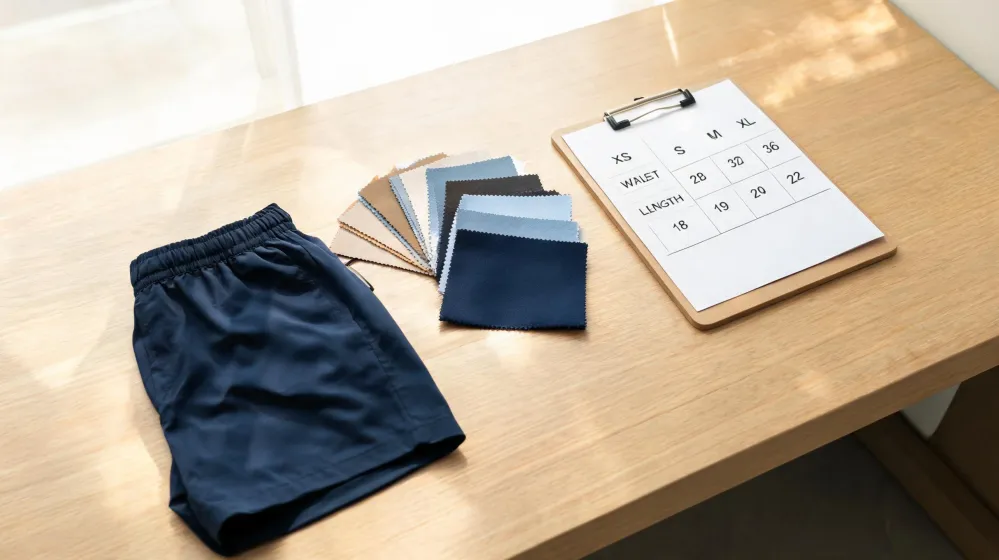
The KTP SW-1 sample comes out of its bag on my receiving desk on the first morning, and my thumb finds the back pocket grommet before I have unfolded the leg. A grommet is the metal eyelet set into the fabric so water and sand pass through instead of pooling. The pocket flap is folded back against the body panel, the print across the two pieces nearly lines up, and the approval sheet in front of me is blank, because nobody in the room has agreed what its first line should say. Two people will look at this pocket today and describe it differently, and both descriptions will sound correct.
Everything below concerns the KTP SW-1 board short as the reference, with the Toplevel Sportswear dye-sublimation boardshort held separately as a comparison build; the two never share a parameter line. The argument is narrow: pocket approval fails at the written-spec stage, not at the design stage. If the drainage feature, the closure type and the pocket-to-panel alignment are not pinned to a named model before the sample is cut, the eye decides instead of the checklist, and the eye changes its mind in week two. The order below is the one I use — written spec first, the three objects that belong on the desk, first-week checks against the written answers, an alignment rule for printed fabric, week-two repeatability, and a three-month re-check that reopens the same bag.
Day One and the Sample on Your Desk
Before anyone offers an opinion about how the pocket looks, three objects have to be on the desk: the physical sample with its bag and model label intact, the written pocket answer from the supplier, and a blank sheet with a column for the model name. The model name is what keeps one build from silently absorbing the habits of a different factory. On the KTP SW-1 the first line I write is the drainage feature, the second is the closure, the third is the alignment between pocket and body panel — the order a wearer meets them, and the order they fail. Drainage comes first because it is settled by a hole: the panel either has a passage for water or it does not, and a reviewer who is unsure can be sent back to the same question. The closure is second because it is a named component, and component names drift once they are retyped in email. Alignment is last because it is the one item that genuinely needs judgement.
Two Pocket Builds Ask Different Approval Questions
The KTP Design Company SW-1 board short is described with a back pocket that has a grommet for drainage and a hook-and-loop closure. Hook-and-loop is the two-tape system most people call by a brand name: one face of small hooks, one face of loops, pressed together and peeled apart. That hands an approver two checkable items — a drainage passage located on the back pocket, and a closure type — and says nothing about a front pocket or a zipper.
The same product page states that the pattern on the garment is matched to the pattern on the pocket. That sentence is where the alignment question starts, and it also sets the limit: it describes an intention to match, not a measured allowance. The Toplevel Sportswear dye-sublimation boardshort is described differently, with mesh-lined hand and back pockets, a Flex-Zip closure and edge-to-edge dye sublimation. Mesh lining is an open-knit liner behind the pocket bag that lets water out; Flex-Zip is that supplier's own name for its zipper; dye sublimation is a print process in which ink turns to gas and bonds into polyester fibre.
A line reading drainage present is meaningless once you move from a grommet in a back pocket to a mesh-lined pocket closed with a zipper, because the water leaves by a different route and the closure is a different mechanism. Every line on my sheet carries the model it came from.
Write the Pocket Spec Down Before Anyone Sews
The request list I send before cutting is written as questions with a blank after each one, not as assumptions. First line: state the reference model you are quoting against, using the full name as it appears on the sample bag, so the answer can be filed next to the sample. Second: which closure will the pocket use, and what is its exact type name as you buy it. Third: is a drainage feature included, on which pocket, and by what construction — an eyelet, a mesh panel, or something else. Fourth: where is the pocket pattern positioned relative to the body panel print, and who signs off that position. Fifth: how is pocket placement graded from the smallest size to the largest, since grading — scaling one pattern across the size run — is where a matched pocket most often comes apart.
What the list deliberately leaves out is price, minimum order quantity, production capacity, lead time and certification. None of those were captured for this topic, so they stay as open items each candidate supplier has to answer in writing. A page describing a pocket construction tells you what that model does; it tells you nothing about who can make it, in what volume, at what price, or under which certificate. Folding the two into one document is how a purchase order gets approved against a marketing page.
First Week Checks That Confirm the Spec
In the first week the sample is not examined for beauty, it is examined against the answers. Put the closure sewn on the sample next to the closure named in the written reply; the two either read the same or the line fails, and a fail goes back as a written question rather than a phone call. Find the drainage feature and confirm it sits where the written answer placed it — back pocket or side pocket, eyelet or mesh — because a feature on the right garment but the wrong pocket is a different product.
The third check is clerical, and it is the one that gets skipped: confirm that the model name on the supplier's written answer matches the model name on the sample bag, character for character. An approval that cannot be traced to one model name is an opinion with a date on it. Done right, the file at the end of week one holds a supplier answer, a sample, and a sheet where every line shows a model name and a pass or a fail, with no line carrying a comment like looks fine.
What Pattern Alignment Means on Printed Fabric
On a printed panel, alignment is two things and only two: pattern continuity across the seam where the pocket meets the body, and consistency of the pocket shape from unit to unit. Continuity is a print-layout question — the artwork has to sit on the cut pieces so the motif running down the leg resumes on the pocket flap at the same point in the repeat. Consistency is a cutting question. A factory that plans print layout after the cutting marker is set can deliver neither, however carefully the sewer works.
Neither product page gives an alignment tolerance, and I am not going to invent one. Tolerance here means the permitted offset between the motif on the body panel and the motif on the pocket before the unit is rejected, and with no stated number the honest move is to ask the supplier for its own written rule, then decide whether that rule is tight enough for the print you chose. Ask it in the same message as the closure question, because a supplier that answers one and dodges the other has told you something about the file you are building.
Week Two Repeatability Across Sizes and Colorways
By the end of week two the alignment check has to survive a change of size and a change of colorway — the specific colour and print variant of a style, each normally sampled and approved on its own. That means one written alignment rule per size grade, one retained reference photo per colorway, and one fixed description of how the sample was viewed: distance, light, and whether the garment lay flat or on a form. Viewing conditions written down are what stop two reviewers disagreeing about the same seam in two different rooms.
Repeatability also needs the supplier's grading statement in the file. If pocket placement is graded proportionally, the pocket moves with the size and the print has to be laid out per size; if the pocket is held at one size across the run, the print layout faces a different constraint. As a hypothetical, a bulk unit judged against the retained photo in the same light, at the same distance, against the same written rule, is a check anyone on the team can repeat without me in the room. That is the whole value of writing it down — an approval that depends on one person's eye is not an approval, it is a dependency.
Claims to Keep Out of the Purchase Order
The Toplevel page describes its dye-sublimation graphics as permanently embedded in the fabric with no cracking or peeling. That is a supplier describing its own process, not a test result, and it does not belong in a purchase order as an acceptance criterion. My position: strike performance wording of that kind from the approval file and replace it with a question the supplier answers in writing about its own process and its own sample. A document promising no cracking and no peeling gives a QC team nothing to measure.
The same limit runs through the whole file. Nothing captured here supports a durability claim, a drainage-speed claim, a UV or antimicrobial claim, or an environmental-benefit claim for either model, and none of those should appear as a specification line. What the pages do support is narrower and more useful: a grommet and a hook-and-loop closure on one back pocket, and mesh-lined pockets with a Flex-Zip closure and edge-to-edge sublimation on the other. Keep the purchase order to what can be traced to a model and confirmed in writing, and leave everything else in the question column until it is answered.
Three Months Later, Reopen the Same Sample
Three months later, in a hypothetical re-check, the bag comes back out. The retained sample — the approved unit kept sealed as the physical reference — is opened beside the written sheet, a production unit is laid next to it, and the same lines are walked in the same order: closure type against the written closure, drainage feature against the written location, alignment against the written rule and the retained photo. Nothing new is judged. The only question is whether the file still describes what is arriving.
If the production unit matches line for line, the sheet gets a date and a signature and the pocket is closed. If the pocket flap and the body panel do not line up, the first move is not another sample round; it is three specific written questions to the supplier — which size grade was cut, where the print was positioned on the marker, and what alignment rule was applied — because those answers tell you whether you have a cutting problem, a print-layout problem, or a supplier that never wrote the rule down. Then the sample goes back into the bag with the sheet that belongs to it, or it goes back to the supplier with the questions attached. The blank sheet on the first morning is the thing this whole sequence exists to prevent.

Leave a comment