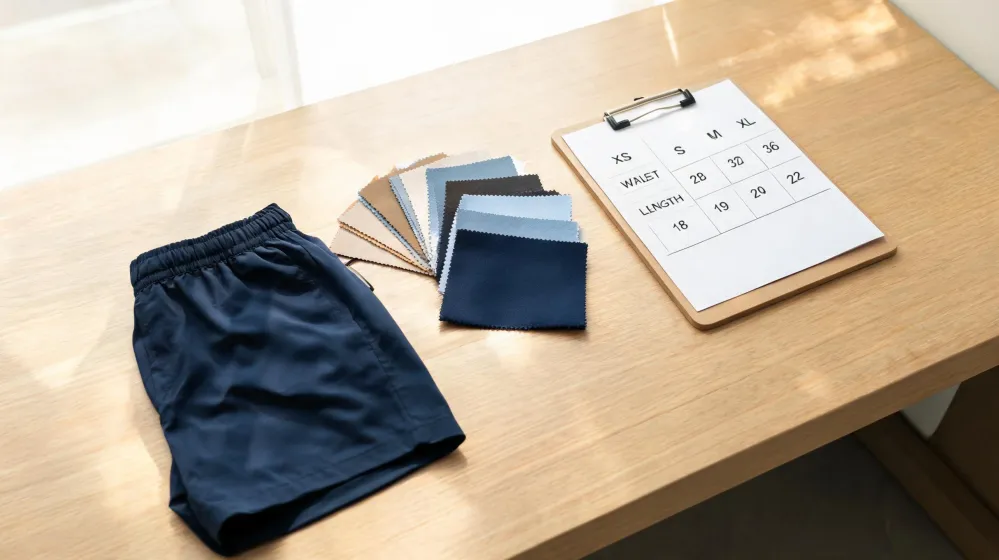
The usual first mistake on a KTP SW-1 sample request is a copy-and-paste. The buyer lifts "quick-drying polyester/spandex" off the supplier page, drops it into the sample sheet, and approves the sample by holding it next to the photo. That sentence names a family of fabric, not a construction, because it was written to describe a garment rather than to be inspected against. Every variable that decides how the cloth behaves is left for the mill to choose, which means two samples can both be correct on paper and still feel like different shorts. A signature given on the first one tells your QC team nothing when bulk fabric shows up from another lot.
The order of work matters more than the wording. On SW-1, the waistband and drawstring questions should be closed before anyone argues about fabric adjectives, since the waist is where fit is won or lost and where a wrong call is hardest to undo. Everything below is scoped to the KTP SW-1 board short as described on the supplier's page. It is not a claim about board shorts in general, and it is not a statement about any factory's capability.
The Mistake That Sinks the First SW-1 Sample
A buyer who pastes a marketing line into a spec sheet has handed the mill the whole decision. Approval needs something to measure against, and "breathable and durable" gives an inspector nothing to reject on. The reason is structural: a material-family phrase describes the class of cloth the garment is cut from, polyester with spandex, and stops there. It says nothing about how much spandex is in the blend, how heavy the cloth is per square yard, which way it stretches, or what surface finish it carries. Those four variables decide how the short hangs, how it behaves when it comes out of the wash wet, and whether the seat bags out after a season of wear.
There is a second cost, and it gets paid later. Once a sample is signed on appearance, the same vague wording travels onto the purchase order, and the inspection criteria on that PO quietly become a photograph. A dispute over hand-feel or stretch then has no boundary to resolve against, and neither side can point to a line that was agreed before the sample was cut.
What SW-1 Board Shorts Actually Are
In one line: the KTP SW-1 is a board short made from quick-drying polyester/spandex fabric described as breathable and durable, with an elastic waist plus a drawstring for a comfortable, secure fit, offered across XS through 5XL.
That is the full extent of what the page commits to. It does not state weight per unit area, spandex percentage, elastic width or recovery, cord diameter, seam type or test method. Nor does it say anything about capacity, minimum order or lead time. Read the sentence for what it is: a description of a garment with three named features. A specification is a different document, and it has to be built with the supplier item by item, in writing, before the sample is cut.
How SW-1 Differs From Gym and Volley Shorts
The construction on SW-1 gives the wearer two ways to hold the short up. Elastic holds by hoop tension, since the band is cut smaller than the body and stretched to grip. The drawstring adds a second closure the wearer tensions by hand. Gym shorts often close on elastic alone, and volley cuts run shorter with a full elastic waist and no cord. On SW-1 the cord is a working part of the fit rather than trim, which means the channel it runs in, where it exits, and how the ends are finished all belong on the spec sheet.
Sourcing attention goes there. Compare a SW-1 inquiry against a plain gym short and the difference comes down to line items that do not exist on the gym style: cord channel length, exit position, cord end treatment, and the eyelet or bartack that stops the cord pulling through. None of those is a fabric upgrade. None of them reads clearly enough from a photo to be approved from a photo either.
Why the Waistband Comes Before the Print
Start from how the waist actually works. An elastic band grips because it is smaller than the body and stretched by it, so the width of the band and its recovery decide two things at once: whether it still holds at the small end of the size run, and whether it digs in at the large end. Elastic also gives up some of its tension with wear and heat. At the point where it stops doing the work, the drawstring carries the load, which means channel length, exit position and cord ends become fit-critical parts rather than decoration.
Which puts the waistband ahead of the print. A colorway or a print placement can be re-run on a later sample with nothing else about the garment changed; a waistband already sewn into the approved sample cannot be re-judged from photographs, and re-cutting it means a fresh sample anyway. So close elastic width, recovery and drawstring hardware first, then spend the design rounds on print. Treat that as a sequencing call for your own sample plan, not a verdict on any factory, because a supplier may handle both stages well and the point is only which order leaves you holding something provable.
One Size Range From XS to 5XL, Many Questions
A size range is a promise of coverage, not a statement about grading. Three endpoints, XS and 5XL and everything between, say nothing about how the pattern changes across the run. Grading is what decides whether one elastic specification still works at both ends: a band that grips correctly on a small waist can bite on a large one, and a drawstring cut to suit the middle of the range can come up short at 5XL or trail at XS.
So a sample approved in a single size proves very little about the rest of the order. Ask which size is the base, what the grade interval is, and which size the counter-sample will be cut in. The supplier page lists sizes only, with no grade rules and no measurement chart, so grading stays an open question and belongs in writing rather than in an assumption that the pattern will hold across the run.
Five Questions to Send Before You Approve
Here is a set you can send as written. One: the fabric composition split, meaning the polyester-to-spandex ratio, plus weight per unit area. Two: stretch direction and surface finish. Three: elastic width and recovery after repeated extension. Four: drawstring channel length, exit position, cord diameter and how the ends are finished. Five: grade rules from XS through 5XL and which size the counter-sample is cut in.
Ask for the answers to be annotated against the physical sample, item by item, so the paper and the garment agree before anyone signs. Be honest with yourself about what the replies prove. They open the sample conversation. They are not a quote, not a minimum order, not a capacity or lead-time commitment, and not a certification. No physical testing has been run or described here, so durability and dry-time claims stay supplier language until you hold your own sample and your own acceptance criteria.
The action for today is small: put those five questions into one email, send it to every candidate supplier on your list, and ask each to reply in the same numbered order so the answers sit side by side for comparison. Hold the order until the annotated sample comes back with each line confirmed in the supplier's own hand.

Leave a comment